How CASL Affects Cold Email Outreach

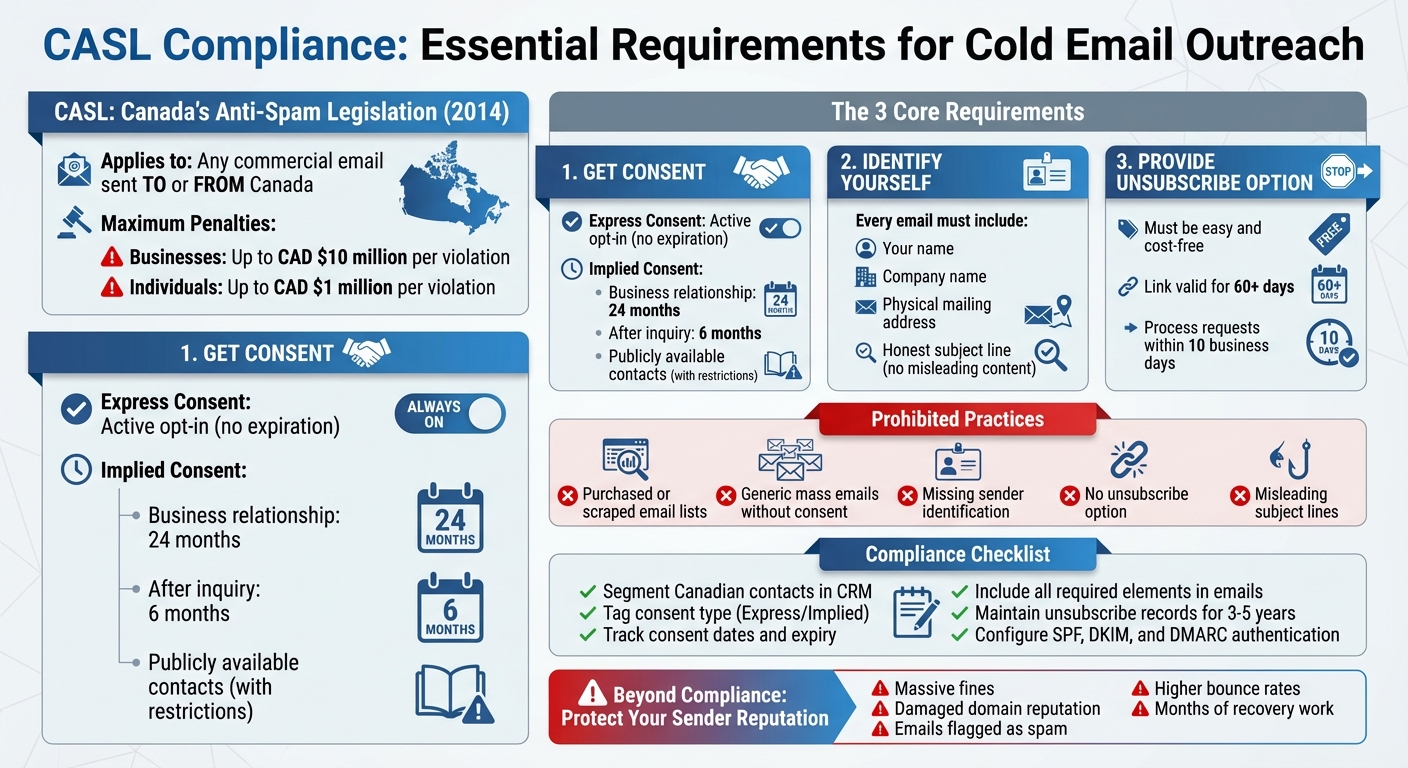
If you're sending cold emails to Canadian prospects, you need to comply with CASL (Canada's Anti-Spam Legislation). CASL, introduced in 2014, is one of the strictest anti-spam laws globally and applies to any commercial email sent to or from Canada. Non-compliance can result in fines up to CAD $10 million per violation for businesses. Here's what you need to know:
- Consent is mandatory: You need express or implied consent before sending emails.
- Clear identification: Include your name, company name, and physical address in every email.
- Unsubscribe option: Provide an easy, no-cost way for recipients to opt out.
Violating CASL not only risks fines but also damages your sender reputation, making it harder for your emails to reach inboxes. To comply, focus on proper list segmentation, track consent details, and avoid risky practices like using purchased email lists. Tools like Salesforge can help automate compliance and maintain deliverability, ensuring your campaigns stay effective and lawful.
CASL Compliance Requirements for Cold Email Outreach to Canada
What CASL Requires: The Basics

What CASL Covers
CASL governs commercial emails aimed at promoting business activities. This includes cold emails advertising products, services, or business opportunities. If you're sending an email to or from Canada, CASL applies - even if your business is based outside of Canada.
Certain types of emails, like transactional messages and personal communications, are exempt. However, if you're contacting a Canadian business prospect to pitch a service or arrange a demo, that qualifies as a commercial email and must comply with CASL.
Now that it's clear what counts as a commercial message, let’s break down the three main rules CASL enforces.
The 3 Core Rules of CASL
When sending commercial emails, CASL requires you to follow these three key rules:
- Get consent before sending. Consent can be either express (the recipient opts in) or implied (based on an existing business relationship or publicly available contact details). Express consent should be well-documented. Implied consent is more limited - it lasts up to two years for active business relationships or six months after an inquiry. It also applies to emails sent to publicly listed addresses, as long as there’s no "no unsolicited emails" notice.
- Clearly identify yourself. Each email must include the sender’s name, the company name, and a physical mailing address (like a headquarters or P.O. box). Misleading subject lines are prohibited.
- Offer an easy way to unsubscribe. Recipients must have a simple, cost-free way to opt out, such as an unsubscribe link. This option must work for at least 60 days after the email is sent, and you’re required to process unsubscribe requests within 10 business days - no extra steps or information needed.
These rules are more than legal obligations - they also help maintain your sender reputation, a topic we’ll explore further in the next section.
What Happens If You Ignore CASL
Violating CASL can lead to steep penalties. Companies can face fines of up to $10 million per violation, while individuals may be fined up to $1 million. Recent cases highlight how severe these penalties can be.
The consequences go beyond financial losses. CASL violations can harm your sender reputation, making it harder for your emails to reach inboxes. Spam complaints can cause email providers like Gmail and Outlook to flag your domain, leading to higher bounce rates and pushing even legitimate emails into spam folders. This can derail your entire cold email strategy, requiring months of effort to rebuild your reputation through list cleanups and gradual warm-up campaigns.
How to Adjust Your Cold Email Strategy for CASL
To align with CASL's rules, refine your email strategy by focusing on proper consent and effective contact segmentation. This involves revisiting your list-building, segmentation, and messaging approaches. These updates not only help you comply with legal requirements but also enhance your targeting and engagement efforts, setting the stage for practical implementation in later sections.
Express vs. Implied Consent Explained
Express consent requires recipients to actively opt in, such as through checkboxes, subscriptions, or double opt-ins. You can gather express consent through activities like webinars, content downloads, or trade show signups where individuals explicitly agree to receive emails. Be sure to document opt-in details, including timestamps, IP addresses, and form data, as proof of compliance. The advantage of express consent is its longevity - it remains valid until the recipient revokes it, making it a reliable foundation for long-term communication.
Implied consent, on the other hand, is common in B2B contexts. It applies when there’s a recent business relationship (within 24 months) or when publicly available business emails are used, provided there’s no indication that unsolicited emails are unwelcome and the message is relevant to the recipient's role. However, implied consent has a time limit: it expires 24 months after the last transaction or 6 months after an inquiry. To stay compliant, track not only who you’re emailing but also when the consent period ends.
Separating Canadian Contacts in Your Database
To ensure compliance, isolate Canadian contacts in your CRM by adding a country field and using tools like IP geolocation, postal code verification, or domain suffix identification (e.g., ".ca"). Tag these contacts with labels like "CASL-Express" or "CASL-Implied" to differentiate them from other segments, such as US or EU contacts.
Platforms like Salesforge simplify this process by offering tagging capabilities and multi-mailbox management. This approach allows you to manage multiple outreach campaigns while automatically excluding unverified Canadian contacts from mass emails. Additionally, you can set up CRM workflows to flag contacts when their implied consent period ends - 24 months for business relationships or 6 months for inquiries. This ensures you avoid accidental violations and keeps your database up to date.
Cold Email Practices That Violate CASL
Once you’ve defined consent types and segmented your contacts, it’s crucial to eliminate practices that could lead to non-compliance. Avoid risky tactics such as using purchased or scraped email lists, sending generic mass emails, omitting sender details, or failing to provide an easy unsubscribe option. Purchased or scraped lists are particularly problematic because they lack verifiable consent and can result in fines of up to CAD $10 million per violation.
Instead, focus on building role-relevant, organically sourced lists through methods like lead magnets, webinars, and content upgrades that encourage express opt-ins. For cold outreach, target publicly listed, role-relevant B2B contacts and prioritize quality over quantity. AI-driven personalization tools, such as those offered by Salesforge, can help tailor messages to each recipient's role, reducing spam complaints and strengthening your compliance efforts. By shifting from mass, untargeted emails to precise, well-documented outreach, you’ll not only avoid hefty fines but also create a more effective and sustainable cold email strategy.
How to Run CASL-Compliant Campaigns: Step by Step
After segmenting your database and addressing any risky practices, the next step is to craft a workflow that integrates CASL compliance into every stage of your cold email process. This includes building a contact list the right way, organizing consent data effectively, and using automation tools to streamline your outreach. Below, we’ll dive into how to create and manage a compliant contact list and use AI to simplify compliance.
How to Build a Compliant Contact List
Start by relying on approved methods to gather verifiable consent. Inbound forms are your best bet for obtaining express consent. Use clear, unchecked opt-in boxes on your website, gated content, or webinar sign-ups. Each form should clearly outline:
- Who is requesting consent (your business name and contact details).
- What types of messages will be sent (e.g., product updates, special offers).
- A statement that users can unsubscribe at any time.
Make sure to record critical details like the timestamp, IP address, source URL, and the exact consent text.
For referrals, document the person who made the introduction, along with the date and context supporting implied consent. For example, if a customer introduces you to a colleague interested in your product, that counts as implied consent. When adding contacts through manual research, stick to publicly available work emails found on corporate websites, LinkedIn, or directories. Ensure the recipient’s role aligns with the relevance of your message. Record the source URL and remember that implied consent typically lasts for up to two years.
Tagging and Organizing Contacts for Compliance
To stay organized, set up dedicated fields in your CRM to track compliance details for each contact. At a minimum, include:
- Country/Region: This helps you identify Canadian contacts subject to CASL.
- Consent Type: Specify whether it’s Express, Implied (e.g., business relationship or inquiry), Publicly Available, or None.
- Consent Source: Note how consent was obtained (e.g., web form, event, referral, manual research, or prior customer).
- Consent Start Date: When consent was first recorded.
- Expiry Date: For implied consent, set this to two years from the last transaction or six months from an inquiry.
For implied consent, establish automation rules to flag contacts nearing expiry. These contacts can then be added to a re-permission workflow or removed from campaigns. While express consent doesn’t have a set expiration, it’s still a good idea to monitor it regularly. Additionally, maintain a global suppression list to ensure that unsubscribe requests are honored across all future communications. These CRM processes, when combined with AI tools, help you maintain compliance effortlessly.
Using AI Tools to Automate Compliance
Once your contacts are organized, AI tools can take compliance to the next level. These platforms simplify consent management and ensure CASL rules are applied automatically. For instance, Salesforge allows you to manage multiple mailboxes from one interface and dynamically adjust contact inclusion based on consent type and geographic location.
Salesforge also automates compliance by inserting CASL-compliant footer blocks into every email. These footers include your business name, postal address, and an unsubscribe link. The platform’s centralized unsubscribe management ensures opt-out requests are processed instantly across all campaigns.
Beyond compliance, Salesforge enhances list hygiene with email validation and its Warmforge warm-up feature, which protects your sender reputation. Its AI-powered SDR, Agent Frank, automates email sequences, adjusting cadence and messaging based on engagement and consent status. With tools for multilingual content creation and AI-driven personalization, you can tailor messages to each recipient’s professional role while meeting CASL’s relevance standards. By combining consent-aware automation with deliverability optimization, you can scale your outreach without sacrificing compliance or quality.
Writing CASL-Compliant Email Content
After organizing your contact list and tracking consent, the next step is to create email templates that align with CASL’s requirements while still capturing your audience’s attention. Every commercial email must include specific elements, and missing any of these can lead to hefty fines. Beyond compliance, your content should be engaging, tailored to your audience, and transparent to avoid spam complaints. Below, we’ll cover the essential components, discuss how to personalize emails under implied consent, and explore how AI tools can simplify the process of creating compliant content at scale.
Required Elements in Every CASL-Compliant Email
To meet CASL standards, every commercial email must include these four key elements:
- Sender Identification: Clearly state your business name, a valid email address in the "From" and "Reply-To" fields, and contact details, such as a phone number.
- Physical Postal Address: Provide a physical address for your business, whether it’s your headquarters, office, or a registered P.O. box. Ensure the address is officially registered if using a P.O. box.
- Honest Subject Line: The subject line must accurately reflect the content of your email. For example, a subject like “Quick question about your team’s CRM needs” is acceptable, while “Urgent: Your account will expire!” would not be, unless it’s true.
- Unsubscribe Mechanism: Include a clear, one-click unsubscribe link that remains active for at least 60 days and processes opt-out requests within 10 business days.
| CASL-Required Email Elements | Description |
|---|---|
| Sender Identification | Business name, email, phone number, and clear contact details |
| Message Purpose | Clearly state why you’re reaching out |
| Postal Address | A physical business address or registered P.O. box |
| Unsubscribe Mechanism | A functional link valid for 60+ days, processing opt-outs within 10 business days |
| Honest Subject Line | A subject line that truthfully reflects the email’s content |
Including these elements not only ensures compliance but also builds trust with recipients, reduces spam complaints, and improves email deliverability.
Personalizing Emails Under Implied Consent
Implied consent allows you to contact publicly available business emails - such as those listed on websites, LinkedIn profiles, or directories - provided the message is relevant to the recipient’s role and there’s no indication they want to avoid unsolicited emails. Personalization is key here since generic messages often fall flat. Tailor your emails to the recipient’s role and responsibilities to make them more effective.
When crafting personalized emails under implied consent, ensure all mandatory CASL elements are included and keep records of where you found each contact. For example, if you’re reaching out to a sales director at a B2B company, you might write:
“As the sales director at XYZ, you may find AI-powered lead generation valuable for reducing prospecting time by 50%.”
Also, remember to track the expiration of implied consent - two years for ongoing relationships and six months for one-time inquiries.
How AI Can Help with Compliant Content
AI tools can take the complexity out of creating CASL-compliant emails while keeping them engaging and personalized. Platforms like Salesforge offer AI-driven personalization features that craft role-specific, multilingual emails. These tools automatically include compliant subject lines, sender identification, physical addresses, and unsubscribe links, saving you time and effort.
For example, Salesforge’s AI SDR can generate messages tailored to a recipient’s role and pain points. If you’re contacting a CTO at a Canadian tech company, the AI might create something like:
“Based on your role as CTO at ABC Inc., here’s how our AI solution can streamline your prospecting efforts.”
Additionally, Salesforge supports multilingual content creation, allowing you to reach international contacts without manual translation. AI-driven personalization has been shown to boost reply rates by 2-3 times when the content aligns closely with the recipient’s role. With features like Warmforge to enhance deliverability, these tools help you scale outreach efforts without compromising quality or compliance.
Maintaining Deliverability and Reducing Risk
Once your email campaigns are CASL-compliant, the next hurdle is making sure those emails actually land in inboxes - not spam folders. Compliance is just the first step. To truly succeed, you need to actively manage your sender reputation, keep detailed consent records, and use the right tools to scale responsibly. Skipping these steps can lead to blocked domains, hefty fines, and campaigns that never reach their audience.
Tracking Consent and Unsubscribe Records
Detailed record-keeping is your safety net if your CASL compliance is ever questioned. You’ll need to document the type of consent, where it came from, and the exact date and time it was given. For implied consent, also track the expiration date - 24 months after a purchase or 6 months after an inquiry. When someone unsubscribes, log their information, the date, the channel they used, and confirm their request was processed within the required 10 business days.
To stay organized, use your CRM to centralize this information. Fields like "CASL consent type", "Consent source", "Consent date", and "Implied consent expiry" make it easy to track. Tags such as "Canada – Express", "Canada – Implied (expires 12/13/2027)", or "Canada – No consent / Unsubscribed" allow your sales team to quickly filter contacts. Automate processes to downgrade expired implied consent, suppress unsubscribed contacts, and log every change in an audit trail. Experts recommend holding onto these records for 3–5 years to demonstrate compliance during investigations. Regular monthly audits can help ensure your data stays accurate and aligned across systems.
Once your records are in order, protecting your sender reputation becomes the next critical step.
Protecting Your Sender Reputation
Your domain reputation is a cornerstone of successful email campaigns, and it depends on more than just good record-keeping. Violating CASL doesn’t just risk fines - it can harm your reputation with mailbox providers. Sending emails without valid consent often leads to spam complaints and "this is junk" reports, which Internet Service Providers (ISPs) use to gauge your credibility. High complaint rates can result in your emails being throttled, sent to spam, or outright blocked. Even compliant emails may suffer if your domain reputation takes a hit.
To safeguard your reputation, make sure your domain is properly authenticated. Configure SPF, DKIM, and DMARC for all sending domains. SPF ensures your sending service’s IPs are authorized, DKIM verifies the integrity of your content, and DMARC enforces alignment policies. Start with a monitoring policy (p=none) and gradually move to stricter enforcement (p=quarantine or p=reject) as you verify alignment. Using dedicated domains or subdomains for outbound sales can also help separate your sales emails from corporate communications.
Beyond authentication, validate email addresses before sending campaigns, warm up new domains and mailboxes gradually, and maintain consistent sending patterns to avoid sudden spikes. Keep a close eye on key metrics like open rates, reply rates, bounce rates, spam complaints, and blocklist status. This allows you to pause or adjust campaigns before any serious damage occurs.
Jake Kitchiner, Co-Founder of ChannelCrawler, shares his success: "We've been running small campaigns because I want our email infrastructure to stay strong over a long period of time. But the warm-up process, spintax, and inbox management are all winners for us." His approach resulted in an 85.71% positive reply rate.
Carlos Palop Moliner, CEO at UniteSync, echoes this sentiment: "Cold email only works when it lands. That's where Salesforge and Mailforge have made the difference." His team achieved an 85.26% positive reply rate and a $2.86 Customer Acquisition Cost (CAC) by focusing on deliverability.
Scaling Compliant Outreach with Centralized Tools
Managing compliance manually - like using spreadsheets - can quickly become unmanageable as your email volume grows. It’s all too easy for consent expiration dates to go unnoticed, unsubscribed contacts to get emailed by mistake, or audit trails to be incomplete. Without a centralized system, proving compliance during a regulatory inquiry can feel impossible.
AI-driven platforms like Salesforge simplify this process by centralizing consent fields, unsubscribe statuses, and country tagging in one system that syncs across all connected mailboxes. The platform automatically enforces country-specific rules, including stricter CASL standards for Canadian contacts. It blocks sequences to contacts without valid consent and ensures no emails are sent to unsubscribed users, regardless of the mailbox.
Salesforge offers tools like programmatic cold email capabilities, integrated Warmforge for unlimited email warm-up, built-in validation, and multi-mailbox management. These features help you scale up your email volume without sacrificing deliverability. Its AI SDR, Agent Frank, is designed to respect consent windows, include required identification and unsubscribe elements, and adjust email cadence based on engagement to minimize complaints.
For teams, this means you can segment Canadian contacts, apply CASL-specific consent logic, validate and warm up sending domains before scaling, and cap daily sends per mailbox. Agent Frank personalizes each message while staying compliant, tailoring content to the recipient’s role - a key requirement for implied consent under CASL. It also ensures every email includes compliant identification and unsubscribe options. By centralizing suppression lists and consent data, the platform prevents contacts from being emailed after their consent expires or after they unsubscribe. This keeps both legal risks and deliverability issues low, even as you scale your outreach programs across multiple mailboxes.
Conclusion
CASL stands out as one of the toughest anti-spam laws in the world, applying to any commercial electronic message sent to or from Canada. To comply, you must focus on three key elements: securing consent, clearly identifying yourself, and including a functional, no-cost unsubscribe option. This isn’t just about checking a legal box - it’s a financial safeguard as well.
The strategies discussed - such as segmenting Canadian contacts, tracking consent details and expiration dates, ensuring sender information and unsubscribe links are included, and tailoring messages within consent boundaries - lay the groundwork for CASL-compliant outreach. Keep in mind, implied consent is limited in scope and duration, while express consent, backed by documentation like timestamps and source details, offers the most secure legal foundation. By prioritizing express consent, you can scale your outreach confidently without risking legal trouble.
Automation plays a crucial role in balancing compliance with efficiency. Following CASL doesn’t mean your outreach has to lose its edge. By focusing on relevant prospects, crafting personalized messages that resonate with their roles, and making opting out straightforward, you can build trust and improve your email deliverability. Advanced tools simplify compliance-heavy tasks like managing unsubscribe requests, maintaining suppression lists, tracking consent, handling domain authentication (SPF, DKIM, DMARC), and regulating email volumes, so you’re not bogged down by manual processes.
Platforms like Salesforge make compliance easier by enforcing country-specific rules, blocking sequences for unverified contacts, and automating unsubscribe management. With features like AI-driven personalization for role-specific messaging, unlimited email warm-up via Warmforge, built-in validation, and multi-mailbox management, Salesforge enables teams to scale their outreach while maintaining compliance. Its AI SDR, Agent Frank, handles tasks from prospecting to follow-ups, ensuring all messages respect consent windows and include the required sender details and unsubscribe options. These tools help keep your outreach effective while staying within legal boundaries.
FAQs
What’s the difference between express and implied consent under CASL?
Under CASL, express consent is when someone gives you clear and explicit permission, like signing up through an opt-in form or agreeing verbally. It’s straightforward and leaves no doubt about their approval.
Implied consent, however, is based on an existing relationship or certain actions. For instance, it might apply if someone has publicly shared their contact details or maintains an ongoing business relationship with you. That said, implied consent comes with tighter rules and often has an expiration date, so staying compliant is crucial.
How can businesses track and manage consent to comply with CASL regulations?
To meet CASL requirements, businesses need to implement a straightforward opt-in process for collecting consent. It's equally important to keep thorough records detailing when and how that consent was obtained. Regular updates to these records are essential to ensure they remain accurate and compliant over time.
AI-powered tools can make this process much easier by automating tasks like tracking consent, monitoring email interactions, and identifying potential compliance risks. These technologies not only cut down on manual work but also help businesses stay ahead in adhering to regulatory standards.
What happens if you don't follow CASL rules in your cold email campaigns?
Failing to follow CASL regulations can bring about severe repercussions for your business. Companies could be hit with fines as high as $10,000,000, not to mention the possibility of legal challenges and damage to their reputation.
Beyond the financial and legal risks, non-compliance can wreak havoc on your cold email campaigns. It can lead to higher spam complaints, lower deliverability rates, and even the risk of being blacklisted. These setbacks can drastically reduce the success of your outreach efforts and make it harder to build connections with potential clients.